May is EDS Awareness Month. But what exactly is Ehlers-Danlos Syndrome (EDS)?
EDS is an acronym for a group of 13 genetically identified connective tissue disorders. These conditions are caused by mutations in genes that encode connective tissue structures or the enzymes that affect them. While genetic testing exists for 12 of these subtypes, the most common form - Hypermobile EDS (hEDS) - is diagnosed clinically, as no specific genetic test is currently available.
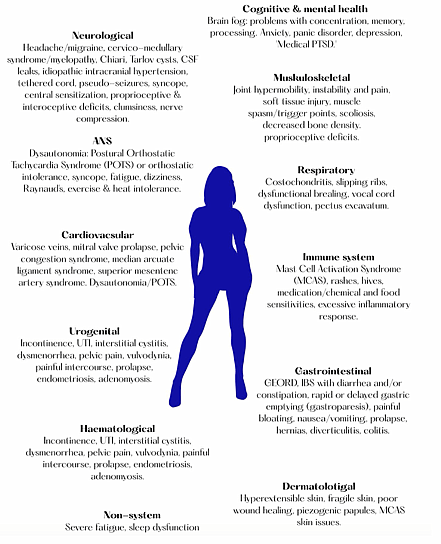
Symptoms vary significantly between subtypes, but common indicators include joint hypermobility, hyperextensible skin, poor wound healing, chronic pain, and easy bruising. For a detailed overview of symptoms and comorbidities, please refer to the infographic below.
Focus on hEDS and HSD
This article focuses primarily on Hypermobile EDS (hEDS), the subtype most frequently encountered in osteopathic practice. We also include Hypermobility Spectrum Disorder (HSD) in this discussion, as the symptoms are often indistinguishable from hEDS, and many patients share similar clinical challenges.
For clarity, hypermobility refers to the lack of passive stability of the joints, provided by connective tissue like ligaments. It is not the same as being flexible. Flexibility is a function of the muscles, and quite often hypermobile people are tight in their muscles that are desperately trying to provide the stability for the joints. So you can be hypermobile and inflexible at the same time.
As we have connective tissue everywhere in our body, the issues are not always limited to the joints, but can also present in other systems, like the cardiovascular system, gastrointestinal system and urogenital system, to name a few (see the infographic for more details).
Symptom severity ranges from mild to debilitating. While pain is a hallmark, the condition extends far beyond musculoskeletal issues. Fatigue, dysautonomia (difficulty regulating heart rate, blood pressure, and other autonomic functions), gastrointestinal pain, and other comorbidities can significantly impact quality of life.
The Osteopathic Approach
Management of hEDS and HSD requires a multidisciplinary approach. Osteopaths play a vital role by using gentle techniques to:
Regulate the nervous system.
Alleviate soft tissue tension and pain.
Help managing the condition at home and between treatments
The primary goal is to identify underlying comorbidities (such as POTS or MCAS) and symptom triggers, then develop a personalised management plan. A key component of pain management is targeted exercise to build joint stability to address the root cause of pain. However, this must be tailored to the individual. For some patients, stabilising dysautonomia and fatigue is a prerequisite before exercise can be tolerated. Ultimately, maintaining joint stability through appropriate movement is a lifelong commitment.
What You Can Do
Track your symptoms: Keep a diary to identify triggers and helpful strategies.
Prioritise rest: Your body may require more rest than the average person; this is a valid need, not a weakness.
Seek understanding: Find a multidisciplinary team who understands hypermobility to assist with nervous system regulation and pain management.
Mindset: Psychological support and a positive mindset are essential components of chronic condition management.
You don’t have to figure this out alone. The right support can help you understand your body and build lasting stability.
Contact our reception or book online for your first appointment to start formulating your treatment plan!
To find out more about Reg. Osteopath Venla, click here.